Vasavi College of Engineering (Autonomous) · Ibrahimbagh, Hyderabad
ACCREDITED BY NAAC WITH 'A++' GRADE · DEPARTMENT OF COMPUTER SCIENCE & ENGINEERING
Full Stack
Web Development.
One semester. One real project. By the end, you will have designed, built, and deployed a complete web application — front end, back end, database, and cloud — with your own hands. This page is the trailer.
Why this course
You already used full-stack apps today.
Probably before breakfast.
Think about the last two hours of your life as a Hyderabad student. Every tap below is a full-stack web product — a front end you touch, a server you never see, a database remembering everything. This course teaches you to build all three layers.
 Swiggy / Zomato
A menu renders in your browser (front end), your order travels to a kitchen's dashboard (server), and your address, cart, and past orders are remembered (database). You will build exactly this shape — a campus food-ordering app — this semester.
 Instagram
An endless feed built out of components — post card, story ring, like button — re-rendered instantly as data changes. That component way of thinking is Unit 3 (React), letter R of the stack.

 PhonePe / GPay
A payment tap fires a request to an API, gets verified server-side, and returns a response in milliseconds — with a token proving it's really you. APIs, tokens, and services are Units 4 and 5.
Results, attendance, fee receipts — forms in, tables out, a database behind it all. Ordinary-looking, deeply full-stack. By Unit 5 you could rebuild it — and deploy it to the cloud.
The point of the trailer: full-stack development isn't a topic from a textbook — it's the manufacturing skill behind nearly every product on your phone. This semester you don't study that skill from a distance. You practise it, one layer at a time, until all the layers are yours.
The contract
The syllabus — word for word.
No paraphrasing here. What follows is the R-23 syllabus exactly as printed in your scheme booklet — the same text your examiners hold. Every class in this course maps back to a line on this page. One topic is an instructor addition, and it's clearly flagged as one.
VASAVI COLLEGE OF ENGINEERING (AUTONOMOUS) · DEPARTMENT OF COMPUTER SCIENCE & ENGINEERING
FULL STACK WEB DEVELOPMENT
SYLLABUS FOR B.E. V-SEMESTER · WITH EFFECT FROM THE ACADEMIC YEAR 2025-26 · (R-23)
- Develop applications using web technologies.
- Develop and publish REST API.
- Apply HTML and CSS to design web pages.
- Develop dynamic web front end using JavaScript.
- Design a component driven user interface using React.
- Develop back-end application using Node.js and MongoDB.
- Develop and deploy web services to integrate web applications.
Web Basics and Overview : Evolution of the Internet and World Wide Web, HTTP, Introduction to HTML5, Linking, Tables, Forms, Form input Types, HTML5 Structural Elements.
Cascading Style Sheets : Selectors, Properties and Values, External Style Sheets, Positioning of Elements, Box Model and Media Queries.
JavaScript: Introduction to JavaScript ES6, Variables, Objects, Document and Window Objects, Arrays, String Manipulation, Scripting Functions, Event Handling.
React: React Module, Code Sandbox, Templating with JSX, Babel, ES6 Literals, Expressions in JSX, JSX attributes and Styling React Elements, React Components, States and Props, Life Cycle of Components, Stateless Component, Event Handling, Rendering List, Error Handling, Routers, Single Page Application.
Node.js : Setup, Node Life cycle, REPL, Node Modules- FS, HTTP, URL, NPM, Redirecting Requests, Call backs, Events, Blocking and Non-Blocking Code, Node.js with Express, Express -Handling Requests and Responses.
MongoDB SQL and NoSQL Concepts, Create and Manage MongoDB, CURD operations on MongoDB, MongoDB with Node.js, Services offered by MongoDB.
INSTRUCTOR ADDITION — NOT PRINTED R-23 TEXT+ Valkey for caching — one extra closing topic for Unit 4: why a real app puts a lightning-fast key-value cache (Valkey) in front of its database, and how the Poshtik Campus menu gets served from it. Added by your instructor because production MERN apps almost always ship with one; your exams stay strictly on the printed text above.
Web Services: Web Services Architecture, Web Services Technologies - SOAP, REST, Node.js REST API, JSON Web Tokens for Authentication, Microservices Architecture.
Serverless Computing : AWS services, AWS Lambda, Use-Cases, Web application Deployment in Cloud.
Read it like a developer reads a spec: five units, and they stack — structure (HTML/CSS), then behaviour (JavaScript), then components (React), then server & data (Node/Express/MongoDB), then services & cloud (REST/JWT/AWS). Nothing on this list is decoration; each unit is a load-bearing floor for the one above it.
The practical contract
The lab — eleven exercises, one project.
The lab syllabus, also word for word. Here's the twist that makes this course different: these eleven exercises are not eleven throwaway programs. In this classroom they are one application, built in eleven stages — each exercise grows the same project the previous one left behind.
VASAVI COLLEGE OF ENGINEERING (AUTONOMOUS) · DEPARTMENT OF COMPUTER SCIENCE & ENGINEERING
FULL STACK WEB DEVELOPMENT LAB
SYLLABUS FOR B.E. V - SEMESTER · WITH EFFECT FROM THE ACADEMIC YEAR 2025-26 · (R-23)
Why one project instead of eleven programs: exercise 11 says "develop a web application for a given problem statement" — that's a full product. You can't fake your way to a full product in one lab session; you get there by having built it continuously since Lab 1. Your GitHub repo will show that whole journey, commit by commit — which is exactly what recruiters ask to see.
The four letters
What is the MERN stack?
Everything in that syllabus adds up to one industry name: MERN — four technologies that together make a complete web application. Here's your first look at all four. Don't memorise anything today; each letter gets its own full unit later. Just learn their faces.
Definition — write this one down. The MERN stack is a free, open-source collection of four JavaScript-based technologies — MongoDB (database), Express.js (server-side web framework), React (front-end library) and Node.js (JavaScript runtime) — used together to build complete, end-to-end web applications in a single language, JavaScript: React renders what the user sees, Express and Node run the application's server logic, and MongoDB stores its data.
Where the application's data lives — every dish, every order, every user, stored as flexible documents and remembered forever.
The traffic controller on the server — receives every request ("place this order"), decides what happens, sends back the response.
What the user sees and touches — the interface, built from reusable components that update instantly when data changes.
The engine that runs JavaScript outside the browser — on the server — tying the whole stack together in one language.
Why MERN, three ways.
JavaScript writes the interface, the server, and the database queries. You learn one language deeply instead of four languages shallowly — every hour of practice compounds.
Swiggy-style ordering, Instagram-style feeds, booking flows, dashboards — real Indian and global teams build them on exactly this stack or a close variant. You're learning the working industry's toolkit, not a museum piece.
The five units you just read map one-to-one onto the stack: web foundations · the language · R · E+N+M · services and cloud. The roadmap you're about to walk is the stack itself, one letter at a time.
The build order, so you're never lost: R comes first (Unit 3), then E + N + M together (Unit 4) — and by the end of Unit 4 you will have built all four letters with your own hands. Units 1 and 2 first give you the two languages every letter depends on.
The workbench
The toolchain — previewed, not installed.
Relax: today you install nothing. This is just the trailer's tour of the workbench, so that when each tool shows up later, it's a familiar face arriving on schedule — not a surprise. Four stages, matching the course's own timeline.
Chrome and its DevTools are your microscope; VS Code is your workshop; Git + GitHub is your project's memory. These three carry the whole first half — you've already met them.
The moment React arrives, so does Node.js (to run tooling), npm (to install libraries), and Vite (to spin up a modern React project in seconds).
Compass lets you see your database like a spreadsheet; Postman lets you fire requests at your own API before any front end exists. Valkey joins here too — the cache in front of the database.
Deployment day: your app leaves your laptop and gets a real URL on the real internet — AWS Lambda for serverless, Railway hosting for the site and server. Anyone on Earth can visit what you built.
The rule this course keeps: no tool is ever installed before the class that needs it, and no class ever assumes a tool you haven't been walked through. Each stage above arrives exactly when its unit begins.
One project, whole semester
Meet the app you'll build.
THE SEMESTER PROJECT · GROWS THROUGH ALL 11 LAB EXERCISES
Poshtik Campus (పౌష్టిక్ క్యాంపస్)
"Healthy Food, Healthy Body, Healthy Mind" · ఆరోగ్యకరమైన ఆహారం, ఆరోగ్యకరమైన శరీరం, ఆరోగ్యకరమైన మనసు
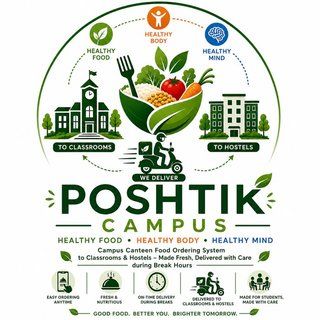
A campus food-ordering app for the problem every hosteller knows: the lunch line is long, and the healthy options — millet bowls, sprouts, protein add-ons — are gone before you reach the counter. Poshtik Campus lets a student browse a genuinely healthy menu, order in a lecture break, and get it delivered to their block. It starts as a single HTML page in Lab 1 (already live if you've done it!) and ends as a deployed MERN application in Lab 12 — jonna rotte wraps, ragi sangati, pesarattu and all.
That's the trailer. Five units read exactly as your examiners will read them, four letters you can now recognise on sight, a toolbench you've toured, and a project worth a semester of your effort. The feature presentation starts in Class 1 — how the Internet actually works.